
Monday, July 6, 2026
Data. Flows. Implications. Every Monday from Dar es Salaam.
Six months in. One signed law. East Africa's electric road has a new frontrunner — and it isn't the country that started with the biggest head start.
We called it on June 16. Three weeks later, it happened.
President Ruto signed the Finance Act 2026 on June 23. As of July 1 — five days ago — every electric vehicle, lithium-ion battery, and e-motorcycle imported into Kenya is subject to a VAT-exempt classification rather than zero-rated status. The practical difference: operators can no longer reclaim input VAT on their cost base. The KSh 46,000 surcharge per motorcycle, the KSh 2.5 million per bus, the KSh 1.1 million per minivan — those are no longer projections. They are today's invoice.
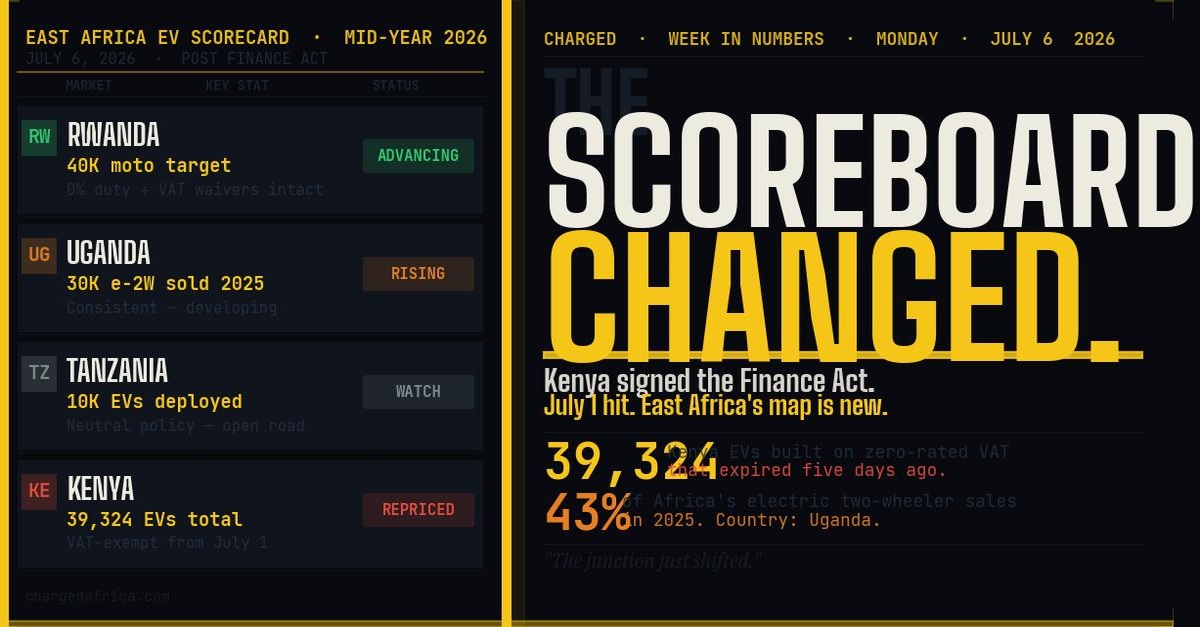
Six months into 2026, East Africa's EV scorecard has been repriced. Here is what it looks like now.
KENYA — THE BIGGEST FLEET, THE MOST EXPENSIVE WEEK
Kenya enters the second half of 2026 with the strongest absolute numbers in the region — and the most complicated operating environment.
39,324 EVs registered cumulatively by end-2025, up from 1,378 in 2022. That is a 2,752% increase in three years, built almost entirely on the assumption that zero-rated VAT status would hold. It did not.
Electric motorcycles now account for approximately 30% of monthly new motorcycle registrations in Kenya — a threshold that, six months ago, felt like a tipping point. BasiGo has 136 electric buses deployed across Kenya and Rwanda (102 and 34 respectively), with more than 1,200 reservations on its order book, a target of 1,000 buses by 2027, and 12 active charging depots. Roam launched its Gen 3 motorcycle in April 2026 — the fastest-charging battery on the African market, 20% to 80% in under 40 minutes — and runs a service centre in Nairobi capable of handling 3,500 units per month. Spiro operates 40 dealerships across 30 of Kenya's 47 counties, with plans to reach all 47 by December.
The market is real. The operators are deployed. The infrastructure is built.
What changed on July 1 is the cost of adding to it.
BasiGo is assembling CKD kits at Associated Vehicle Assemblers in Mombasa. Roam runs assembly at Kenya Vehicle Manufacturers in Thika. Every component imported into those facilities now carries input VAT that cannot be recovered. Local assembly — which was supposed to be the cost-reduction strategy — has become a cost-amplification mechanism. The Finance Act 2026 did not kill Kenya's EV sector. It made every new unit more expensive to put on a road that was already there.
RWANDA — THE QUIET FRONTRUNNER
Rwanda did nothing different in July 2026. That is precisely why it is now ahead.
Zero import duty on EVs: intact. VAT waivers on locally assembled electric vehicles: intact. Ampersand's swap station network: growing. The regulatory environment that made Rwanda the DFI's preferred East African EV destination has not changed — and now, relative to Kenya, it has widened.
Ampersand operates 6,000+ electric motorcycles across Kigali and Nairobi, supported by 25 battery swap stations and processing more than 18,000 battery swaps per day. Its BYD partnership targets 40,000 motorcycles deployed across Rwanda and Kenya combined by end-2026. The Kenya portion of that target just got 10–14% more expensive to achieve. The Rwanda portion did not.
When FEDA (Afreximbank) wrote $75 million into Spiro, when Proparco took an equity stake in BasiGo, when Africa Go Green Fund extended debt to Ampersand — all of those DFI decisions were made partly on Rwanda's policy stability. That stability remains. Rwanda is not winning because it moved faster. It is winning because Kenya moved backward.
UGANDA — THE STEALTH LEADER
The number most East Africa EV coverage misses: Uganda sold more than 30,000 electric two-wheelers in 2025 — representing 43% of all electric two-wheeler sales on the continent that year. A country of 50 million people, frequently absent from the EV headline, outpaced every other African market in unit volume for twelve consecutive months.
Zembo operates 2,000+ electric motorcycles across Kampala and surrounding areas, supported by 100+ solar-powered battery swap stations — one of the few networks in East Africa where the swap station is also the grid. Uganda's model is off-grid by design: solar charging removes the unreliable national grid as a constraint and gives the operator full margin control over energy costs.
Uganda does not have Rwanda's DFI legibility or Kenya's market depth. What it has is a regulatory environment that has stayed consistent, a large boda boda market with demonstrated willingness to adopt, and operators building infrastructure that works regardless of what the national grid does that day.
If Uganda adds a coherent EV policy framework in the second half of 2026 — which its Ministry of Energy has been signalling — it enters 2027 as the most interesting competitive market in East Africa.
TANZANIA THE WILDCARD WITH THE MOST UPSIDE
Tanzania has approximately 10,000 electric two and three-wheelers deployed, the smallest footprint of the four markets and, arguably, the most open runway.
The policy environment is neutral — neither hostile nor actively incentivising. The boda boda and bajaj (tuk-tuk) market is large and price-sensitive. The grid is unreliable outside Dar es Salaam, which makes solar-integrated battery swapping the natural model. There is no dominant operator, no entrenched incumbent, and no policy regime that has yet determined the rules of the game.
From Dar es Salaam, watching the sector's mid-year shift, the Tanzania question is simple: the right operator, with the right swap model, enters the right moment. Kenya's Finance Act has made every competitor's unit economics more compelling relative to what Nairobi now offers. That is a tailwind Tanzania did not manufacture for itself but it is real.
THE CHARGED READ
The mid-year EV scorecard does not look the way January's projections suggested it would.
Kenya was supposed to be the region's anchor — the market with the scale, the local assembly, the policy base, and the DFI relationships to pull the rest of East Africa's electric road north. It still has the scale. It still has the operators. It still has 39,000 EVs on the road built on years of momentum.
What it no longer has, as of five days ago, is the cost structure that underwrote that momentum.
Rwanda did not beat Kenya. Kenya handed Rwanda the advantage and signed the legislation on June 23.
The electric road is still being built. But the junction just shifted.
CHARGED is published every Monday (The Week in Numbers) and Thursday (Deep Signal). Dar es Salaam.