Hey movers
If you have sat in Dar es Salaam traffic, you know the word foleni. It's the queue that eats your morning on Morogoro Road. It's also the most honest survey in the city: it shows exactly where everyone is trying to go.
Money has a foleni too. Last week, it changed direction.
43.6x the longest queue in Cairo
🇪🇬 MNT-Halan (Egypt, founded 2018) started trading on the Egyptian Exchange on 20 October. Its retail tranche was 43.6 times oversubscribed, from 41,500+ orders. Institutions came in at 11.2x. The shares rose as much as 18% on day one, valuing the listed business at roughly $745 million.
Picture a 14-seat daladala at Ubungo with 610 people trying to get on. That's 43.6x.
And what were they queuing for? Not an app. A lender: an EGP 46.7 billion loan book, 1.9 million active customers, and 1,200+ physical points where cash meets code.
One detail most headlines skipped: the ~$150 million was a sale of existing shares by the parent, MNT Investments B.V. None of it went into the company. That isn't a flaw. It's what an exit looks like, the door investors have spent ten years asking African fintech to build.
$59.7M and none of it African
Next door, the venture window was quiet. Techloy's Week 43 tracker for Africa and the Middle East came to $59.7 million. Every round it listed was in Israel or the Gulf.
The window wasn't nailed shut. Disrupt Africa logged a $38 million round for South African-founded clinical AI startup Healthleap. But no sizeable fintech or e-mobility venture round made the wires.
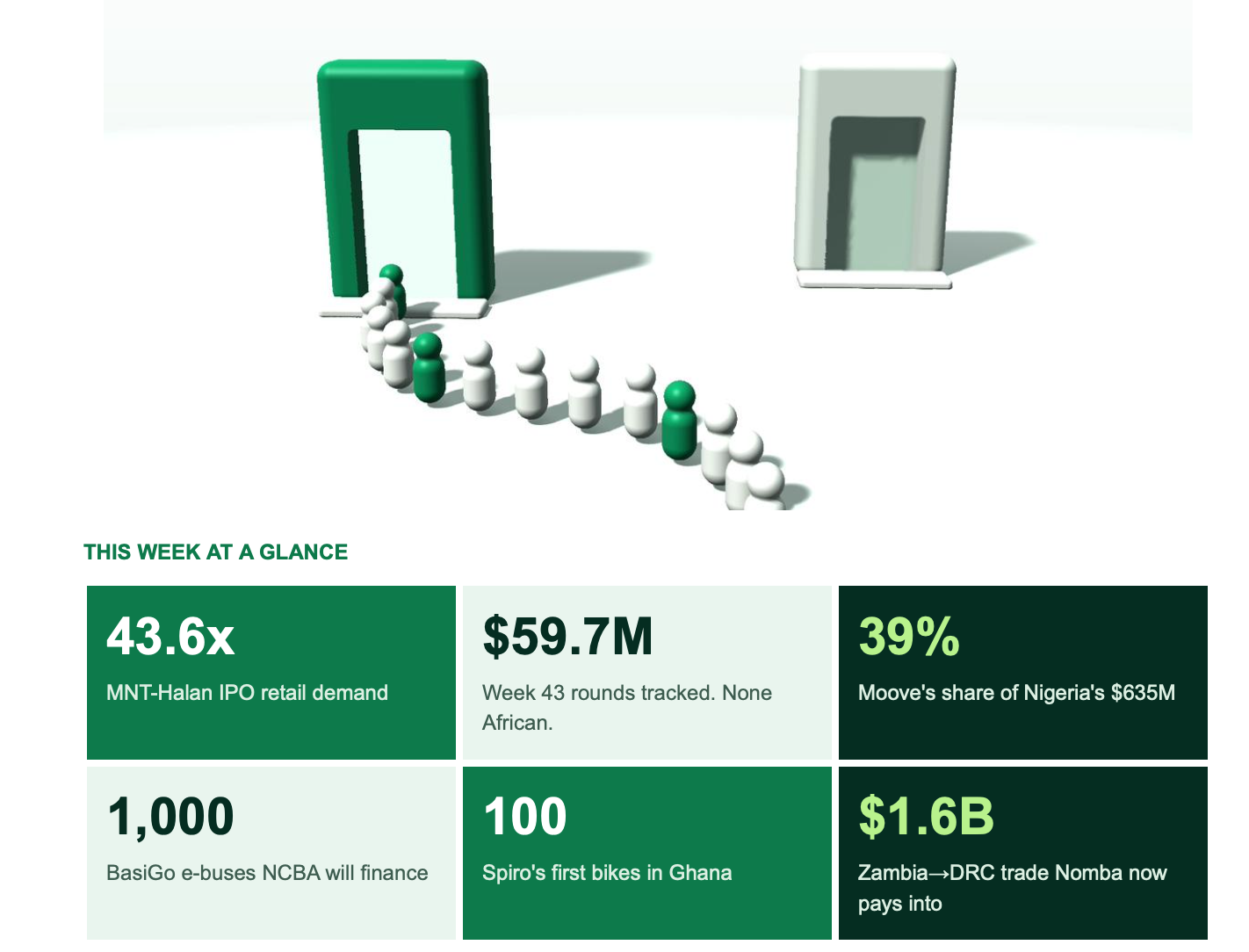
Two windows side by side: one with a queue around the block, and one where the clerk is reading the newspaper.
39% Nigeria's queue has one name at the front
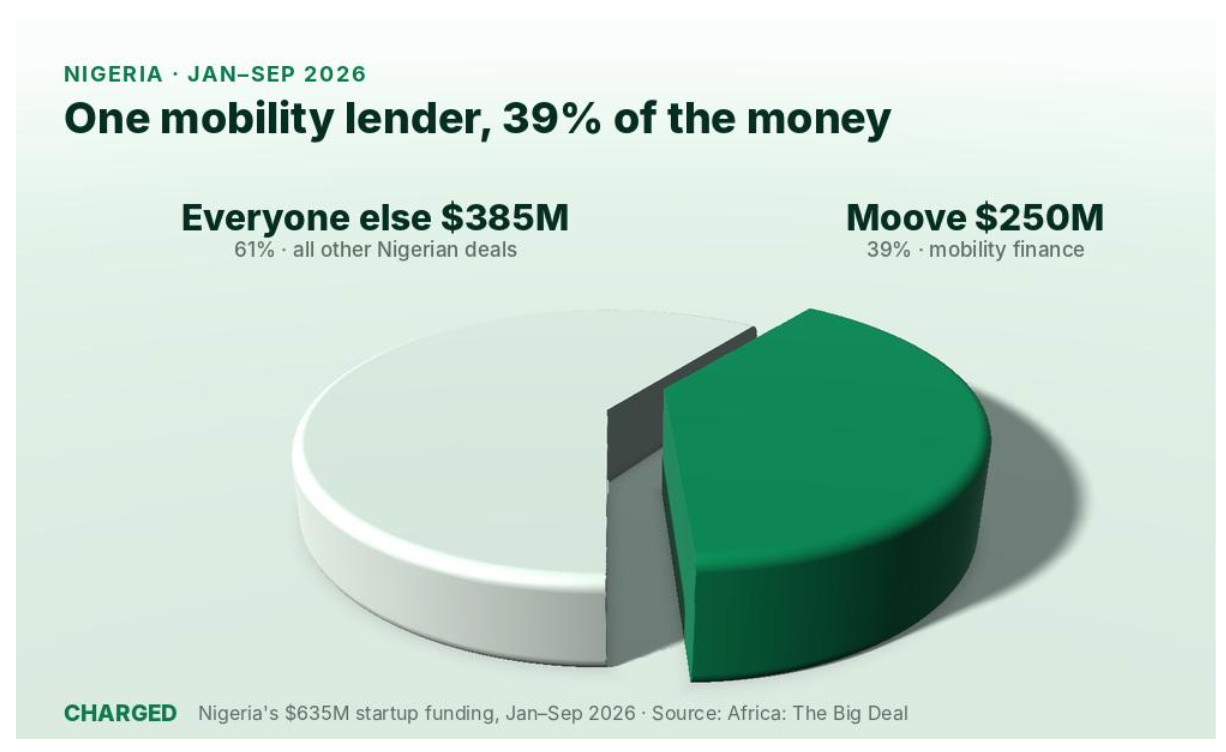
🇳🇬 Nigerian startups raised $635 million between January and September, up 157% on 2025, according to Africa: The Big Deal. Moove's $250 million Series C made up 39% of it.
Moove doesn't really sell cars. It finances them for ride-hailing drivers and gets repaid out of their weekly earnings. So the biggest cheque in Africa's biggest funding market this year went to a mobility lender.
179 → 1,000 the bus that pays its own fare
🇰🇪🇷🇼 BasiGo runs 179 electric buses in Kenya and Rwanda, which have carried more than 15 million passengers. Operators don't pay for the whole bus upfront. Under Pay-As-You-Drive, they spread the battery, charging and maintenance into a fee as they drive, and BasiGo says they save 20–30% on running costs.
Kenyan lender NCBA has agreed to finance up to 1,000 BasiGo vehicles, about 5.6x today's fleet.
Think of a matatu that pays its own fare every time it leaves the stage. NCBA isn't really lending against a bus. It's lending against the rhythm of a route.
100 the front of a brand-new queue
🇬🇭 Spiro handed its first electric motorcycles to 10 riders in Accra last week, the start of a 100-bike launch. Against a fleet of 156,000+ across seven countries, that's 0.06%.
Haba na haba hujaza kibaba: little by little fills the measure. Every rider pays for energy one two-minute swap at a time, so every bike starts producing a repayment record on day one.
$1.6 billion the queue at Kasumbalesa
🇿🇲🇨🇩 Zambia exported $1.6 billion of goods to the DRC in 2025, up about a third on the year before (Bank of Zambia). Anyone who has seen the truck line at the Kasumbalesa border knows those goods can wait for days.
On 21 October, Nomba (Nigeria, founded 2016, $70 billion+ in annualised payments) extended its DRC rails into Zambia. Congolese buyers can now pay Zambian suppliers in francs or dollars, into a bank account or a mobile wallet.
The trucks still queue. The money doesn't have to.
The CHARGED Read
Look at who drew last week's queues: a microlender in Cairo, a car-finance company in Lagos, a pay-as-you-drive bus operator in Nairobi, and a battery-swap network in Accra.
Every one of them lends against something that moves and pays back in small, frequent amounts.
That's the switch. Investors used to queue for promises of growth. Now they queue for receipts: loan books, repayment rhythms and swap logs.
Who pays? The rider, the bus operator and the micro-borrower, a little at a time. Banks like NCBA carry the cost of capital. And on 20 October, 41,500 retail investors in Egypt paid to own a slice of that stream.
At home, the receipts already exist. Tanzania has 87 million active mobile money accounts, and they moved about 2.1 billion transactions in the June quarter (TCRA). That's roughly 23 million a day.