
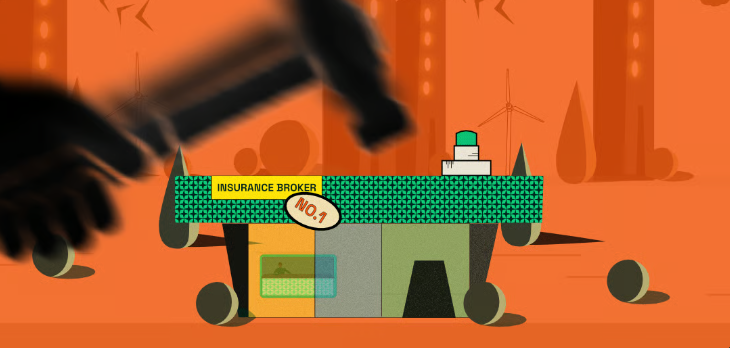
Rwanda just made every battery fit every cabinet. Tanzania did the same thing to money in 2014. We know how this story ends.
Mambo, movers 👋
A century ago, a few engineers chose the width between two railway rails. Nobody voted on it, and nobody remembers their names. East Africa is still paying for that choice.
When two tracks of different widths meet, the train stops and every sack is carried across by hand. Railwaymen call it a break of gauge.
East Africa is now laying a new kind of track, and this one is the size of a shoebox.
The battery is the gauge
Every swap operator built its own line: its own battery, its own cabinet. Spiro runs 135,000+ bikes and 2,500+ stations. Ampersand swaps a battery in about three minutes. ARC Ride just raised $33.3 million to add 5,000 bikes.
That made sense at the start. You build the walls so you get paid for the house.
Now picture a rider at 4% battery, parked beside a rival’s fully charged cabinet that he can’t use. His battery is like a SIM card that can only call its own network.
Three cabinets, three shapes, one stranded rider.
Kigali picks a gauge
On 29 June, Rwanda’s regulator RURA brought Regulation No. 011/Energy/RURA/2026 into force. It’s the first battery-swap interoperability mandate in Africa. Within two years, every new motorcycle must work with approved swap systems, whatever the operator or brand. Stations must also hit 97% uptime and keep waits under 20 minutes.
The technical standard hasn’t been written yet. One Kigali founder called it building a railway “while the gauge is still under discussion.”
He’s right. But a gauge is cheap to choose and ruinous to change, and Kigali is choosing while its fleet is still small.
We’ve seen this film before, in Dar
In 2014, Tigo, Airtel and Zantel signed Africa’s first interoperable mobile money deal. Kenya opened its networks to each other in 2018.
Here’s where each market stands today:
-
🇹🇿 Tanzania: M-Pesa 41%, Mixx by Yas 31%, Airtel Money 18%
-
🇰🇪 Kenya: M-Pesa 88.8%, Airtel Money 11.1%
One is a market. The other is a monarchy.
Interoperability wasn’t the only cause; Safaricom’s head start did plenty of the work. But open tracks let a challenger run trains without first building a whole railway of its own.
Open early vs open late. Sources: Bank of Tanzania 2025; Communications Authority of Kenya, Q2 2026.
Who owns the junction?
On Monday we argued that the bike is the loan officer. Open the cabinets, and a new question appears: when a Spiro rider swaps at an Ampersand cabinet, who gets paid?
Someone has to run the junction. For money, Tanzania already has one: TIPS, which moved TZS 54.95 trillion last year, up 84%.
Batteries will need the same thing. The rider pays per swap, the operators settle overnight, and the switch takes a toll.
Value moves from owning the train to owning the junction. That’s a fintech business hiding inside an energy regulation.
One standard, one junction, every cabinet.
The CHARGED Read
Kenya just signed a KSh390 billion MoU for capacity to build 150,000 vehicles a year. Its fleet is about to grow fast. Tanzania has roughly 10,000 electric two- and three-wheelers and no battery standard.
They say good fences make good neighbours. In e-mobility, good fences make good monopolies.
Kigali chose its gauge with thousands of bikes on the road. Nairobi will have to choose with tens of thousands. Dodoma can still choose for almost nothing.
Mind the gauge.
Should Tanzania set a battery standard now, or let the market crown a winner first?
Written from Dar es Salaam, between two gauges 🇹🇿⚡
CHARGED is published every Monday (The Week in Numbers) and Thursday (Deep Signal).