Hey, movers Peter here 👋
Today I'm talking about a loan officer who has never read a bank statement.
It doesn't visit your house. It doesn't ask for a payslip. It doesn't care who your uncle is.
It works fourteen hours a day in traffic. If you miss a payment, it doesn't send a letter. It just won't start.
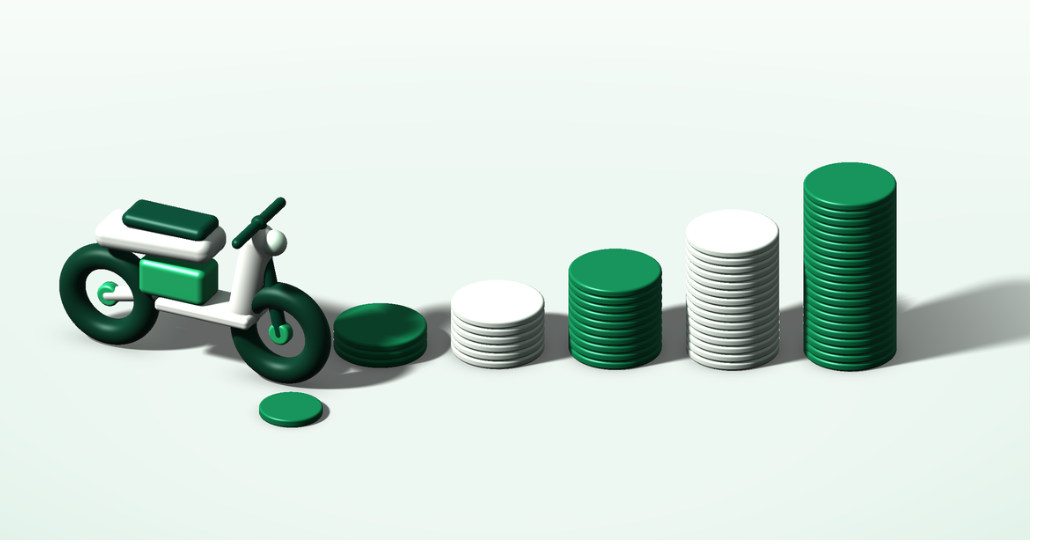
It has two wheels. Sometimes it has a touchscreen instead. Sometimes it's a solar pump.
In September it was the most bankable employee in African tech.
260.3 — the size of the pot
African startups raised $260.3 million in September across 54 disclosed deals. That's down 40% from August's $435.2 million and up 88% on September 2025.
Ten deals took $222.6 million, which is 85.5% of the month.
Picture a wedding where ten guests eat 85% of the pilau and everyone else shares what's stuck to the bottom of the sufuria. You wouldn't call that a feast. You'd call it a queue.
Ten deals, 85.5% of the money. Source: Nairametrics research, September 2026.
580 — the quarter equity came back
Zoom out and the picture is healthier than the queue suggests.
Africa: The Big Deal counts $580 million of equity in Q3, about 2.5x the same quarter last year. Equity for January to September reached $1.5 billion, up 23%. That's the best nine months since 2022.
Debt went the other way. It fell 33% to $669 million, and its share of all funding dropped from 45% to 31%.
Debt used to be the generous uncle who showed up at every harambee. Now he only lends if you leave your ID with him.
So look at where September's debt actually went:
-
🌍 Spiro: $18 million from the Africa Go Green Fund, for bikes and swap stations in Uganda and Rwanda
-
🇰🇪 ARC Ride: $33.3 million in equity and debt, with the debt from BII's Kinetic programme and Mirova
-
🌍 Watu: $7 million in strategic debt for asset financing
-
🇰🇪 SunCulture: $10 million in senior secured financing for solar irrigation
-
🇿🇦 Mission Mobile: up to R500 million (~$30.8 million), much of it ring-fenced debt tied to the smartphones it finances
Every one of these lends against an object that can be located, priced and, in most cases, switched off.
Lenders didn't run out of appetite. They stopped trusting what people say and started trusting what machines report.
Equity up, debt down, January to September. Source: Africa: The Big Deal via The Guardian Nigeria.
50,000,000 — the receipts nobody filed
Spiro now runs more than 135,000 electric motorcycles and 2,500+ swap stations across seven countries, and has completed more than 50 million battery swaps.
Do the division. That's roughly 370 swaps per bike.
Each swap is a rider paying for energy on time. So that's 370 small receipts per bike, each one proof that the rider paid.
No credit bureau on the continent has a file that thick on a boda rider. A battery cabinet in Kampala does.
5,000 — the bikes heading our way
ARC Ride (founded in Kenya in 2019) will use its round, led by Norrsken22 and Novastar with IFC, BII and Proparco alongside, to add 5,000 motorcycles. Its expansion list includes Ghana, Uganda and Tanzania.
Dar es Salaam is on the route map. Our riders already pay daily, in amounts that fit in a shirt pocket. The model fits the market.
75.8 million — the pipes are already laid
The rails for those daily payments are built. Tanzania has 75.8 million active mobile money accounts, more than its population. Its instant payment system, TIPS, moved TZS 54.95 trillion, up 84% (Bank of Tanzania, 2025). Across the border, M-Pesa processed KES 41.68 trillion in the year to March.
The water is flowing through the pipes. What's missing is a meter that remembers who drank it.
The new collateral: a phone, a battery, a padlock.
Little by little fills the measure
. The lesson I keep coming back to is that the problem was never risk appetite. It was data.
The off-switch fixes the data problem by turning the collateral into a sensor.
In Swahili we say haba na haba hujaza kibaba: little by little, the measure fills. We teach it to children as a lesson about saving.
September showed it's now a lending model. A rider pays a little every day, and the bike slowly becomes his.
Who pays? The rider does, daily, in cash-sized pieces. The lender gets paid because the bike can say no.
The proverb skips one question: whose measure is filling?
Right now, 50 million swaps sit in an operator's database. When a rider makes his last payment, does that record go with him to a bank, an insurer or a second bike? Or does it stay in the bike?
The loan officer has two wheels. The next one needs a memory, and the rider should own it.
One number before you go: roughly how many battery swaps has each Spiro bike done? (Answer below.)
About 370. That's 370 on-time payments, and not one of them shows up on a credit report yet.
Written from Dar es Salaam, counting swaps. 🇹🇿⚡