The half-year numbers are in. The headline says funding held steady. The table underneath says the market has fundamentally changed shape and East Africa is on the right side of the shift.
The H1 2026 numbers landed this month, and the comfortable read is that African startup funding is stable: $1.44 billion raised in the first six months, marginally ahead of the $1.42 billion recorded in the same period last year.
Do not take the comfortable read.
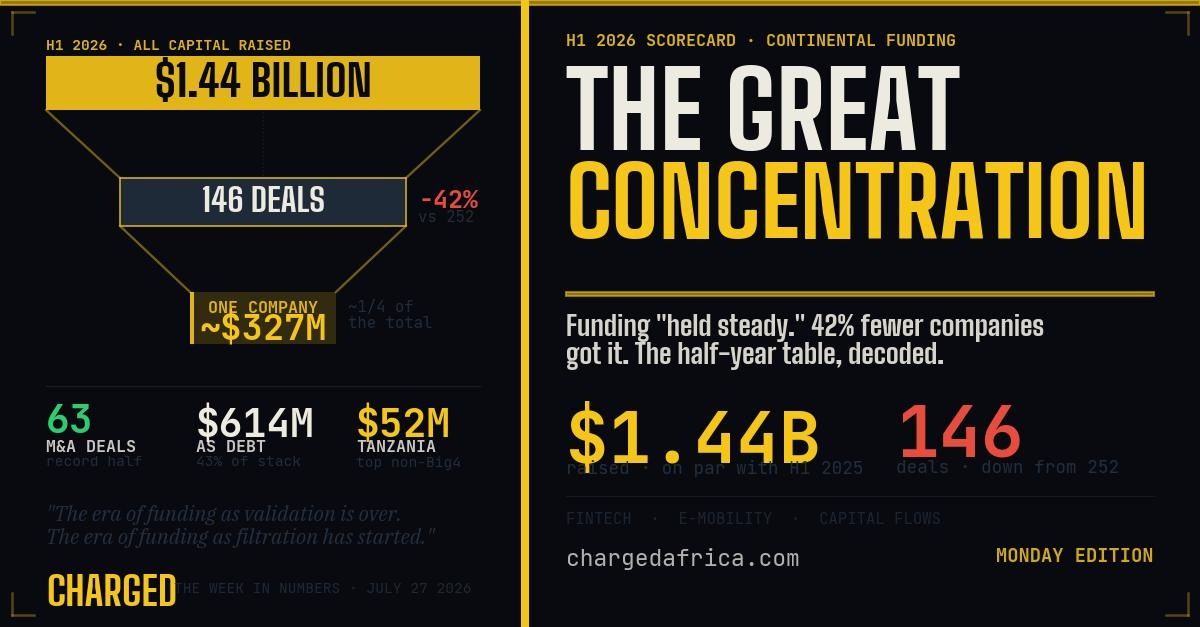
That $1.44 billion was spread across just 146 disclosed deals down from 252 in H1 2025. That is 42% fewer companies getting funded, for the same amount of money. The average cheque nearly doubled. And when you look at where the largest cheques went, one name absorbs the table: Spiro, the pan-African electric motorcycle operator, raised approximately $327 million across four rounds in the half including its $215 million equity round announced June 1. One e-mobility company took somewhere between a fifth and a quarter of everything raised on the continent.
This is not a funding recovery. It is a funding concentration. And the second number that proves it is the one almost nobody is writing about: 63 M&A transactions closed in H1 2026, against 33 in the same period last year the busiest half-year for acquisitions in the history of African tech.
Fewer cheques. Bigger cheques. Record consolidation. Here is what the table actually says.
THE CAPITAL STACK: DEBT DIDN'T RETREAT. IT INSTITUTIONALISED.
Regular readers will remember the June 19 Deep Signal on development finance becoming Africa's EV growth engine. The H1 data confirms the thesis at continental scale.
Of the $1.44 billion raised, roughly $818 million came as equity, $614 million as debt, and $9 million as grants. Debt is now 43% of the capital stack for the half and the debt that got written went overwhelmingly to companies with recoverable assets: MNT-Halan's $41.3 million debt facility in Egypt, Blnk's $37.1 million mixed package, and the asset-backed layers inside Spiro's stack.
The pattern we identified in June holds: the institutions with the deepest pockets are no longer at the equity cap table. They are in the debt stack, secured against batteries, fleets, and receivables. Equity flowed to a shortlist. Debt flowed to balance sheets.
Who pays, and how? In H1 2026, the answer was: lenders pay, and they pay against collateral. If your company cannot answer the "what do we repossess" question, you were competing for a shrinking pool of equity that 146 companies split and four of them (Nala, LemFi, Africa GreenCo, Bfree) took $100 million of May's $135 million total by themselves.
THE SECTOR TABLE: MOBILITY ATE THE HALF
Mobility and climate-tech was the undisputed heavyweight sector of H1 2026 — and that is a structural break worth sitting with.
For a decade, "African tech funding" was a polite synonym for "African fintech funding." Payments companies raised the mega-rounds; everything else fought for the remainder. In H1 2026, the single largest capital consumer on the continent was a company that assembles electric motorcycles and builds battery swap stations. Spiro's $327 million half-year is larger than the total H1 funding of most African countries' entire startup ecosystems.
The reason is the one this newsletter has been documenting all year: e-mobility operators have assets. A swap station network is collateral. A deployed fleet is a repayment schedule. Fintech's capital advantage was always narrative velocity e-mobility's is balance sheet legibility, and in a debt-heavy market, legibility wins.
Egypt remained the dominant single destination for capital in the half, anchored by MNT-Halan's repeat raises. Nigeria led pure equity flows at $214 million. But the sector crown moved and it moved to hardware on wheels.
THE EAST AFRICA LINE
Two East African numbers in the H1 table deserve more attention than they are getting.
Kenya raised $126 million in total funding third on the continent but only $46 million of it was equity. The gap between those two figures is the whole story of Kenyan tech in 2026: the market's clean-energy and mobility hardware companies (d.light, Sun King, M-KOPA, BasiGo) can borrow against assets, while its software startups compete for an equity pool that has thinned dramatically. Kenya's July 1 VAT reclassification covered in our July 6 scorecard will not make that equity conversation easier for EV operators whose unit economics just got repriced.
Tanzania raised $52 million — the highest total of any country outside the Big Four. Read that again. The market that most pan-African funds still classify as "frontier" out-raised Ghana, Senegal, and every other non-Big Four ecosystem on the continent in H1 2026. From where this newsletter sits in Dar es Salaam, that number is not a surprise it is a lagging indicator of capital that has been quietly moving into Tanzanian energy, logistics, and agritech for two years. The runway argument we made on July 6 is no longer just about policy neutrality. There is now a funding line to point at.
THE M&A NUMBER IS THE REAL HEADLINE
Sixty-three acquisitions in six months. Nearly double last year's pace. The busiest half-year on record.
Consolidation at this speed means one of two things, and usually both: acquirers see assets priced below replacement cost, and founders see a financing environment where selling beats raising. With 106 fewer companies getting funded in H1 2026 than a year earlier, the arithmetic is unforgiving the startups that missed the 146-deal cut are not all dying quietly. Many are becoming someone else's market entry.
Expect this to accelerate in H2, and expect e-mobility to be a theatre for it. Fragmented battery-swap networks with incompatible standards the exact problem Kenyan riders were complaining about in the press this month are a textbook consolidation setup. The operator with DFI-grade capital costs buys the operator without them.
THE CHARGED READ
The comfortable story about H1 2026 is resilience: African startups raised as much as last year despite a global slowdown. The accurate story is selection: the same money, half the companies, record acquisitions of the rest.
Having raised for Ramani through a market turn, I can tell you what this feels like from the founder's side of the table: the question changes from "what is your growth rate" to "what is your collateral." That question now governs the entire continent's capital stack. It rewards Spiro. It rewards Tanzania's asset-heavy pipeline. It punishes anyone whose balance sheet is a pitch deck.
$1.44 billion did not flow into African tech in H1 2026. It flowed into about twenty companies that lenders could underwrite and a long tail of acquisitions for everyone else.
The era of funding as validation is over. The era of funding as filtration has started.
CHARGED is published every Monday (The Week in Numbers) and Thursday (Deep Signal). Dar es Salaam